ENERGY
At New Mexico Tech, a federal grant fuels research into critical minerals
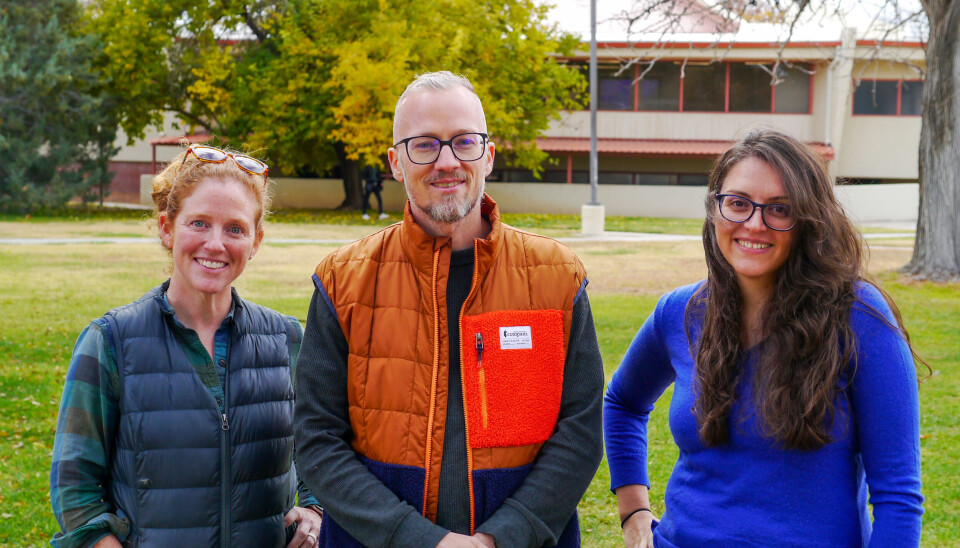
Alexander Gysi believes that understanding when, how and where critical minerals form is essential for U.S. independence in resourcing these elements.
鈥淭hat鈥檚 the first step of exploration,鈥� said Gysi, director of the Ore Deposits and Critical Minerals Laboratory at the New Mexico Bureau of Geology and Mineral Resources in Socorro.
Earlier this month, New Mexico Tech and the Bureau of Geology 鈥� its research division 鈥� received a $2.5 million U.S. Department of Energy grant for a two-year critical mineral project.
Gysi, also an associate professor at NMT, is the project鈥檚 principal investigator. Along with two other leads, the team鈥檚 research will focus on rare earth elements.
鈥淲e are actually trying to understand processes in geologic-natural systems, how these rare earths are mobilized, how they form mineral deposits; and that will also give us information on how to extract them,鈥� Gysi said.
The award comes as Myriad Uranium Corp., a Canadian-based uranium exploration company, has looked at resurrecting its Red Basin Project in New Mexico. The U.S. wants to create a domestic supply chain of critical minerals, like uranium, as the Trump administration continues to battle with countries like China that have an abundance of these elements.
Laura Waters, a co-principal investigator on the project and an NMT professor, said the grant will help fund new research instruments, experiment materials and cover salaries for post-doctoral and undergraduate students involved in the project.
鈥淲e know these rare earth elements come from rocks, but we don鈥檛 necessarily know how they get concentrated,鈥� Waters said. 鈥淵ou can dissolve all kinds of rocks, but if they鈥檙e not concentrated, it鈥檚 just a waste of time.鈥�
Waters said herself, Gysi and Nicole Hurtig 鈥� another project co-principal investigator, NMT assistant professor and manager of the Bureau of Geology鈥檚 Raman Spectroscopy Laboratory 鈥� will each run experiments in different temperature ranges.
The experiments will help the team determine thermodynamics 鈥� a branch of science looking at the relations between heat and other forms of energy 鈥� associated with critical mineral reactions. That data can then be used to better understand how these mineral deposits form in geologic systems, ultimately developing predictive models and new technologies to locate, extract and refine the resources, Gysi said.
鈥淲e are trying to provide geochemical vectors (researchers) can use to interpret mineral exploration data to be able to be more efficient and understand where they are with respect to the mineral deposit,鈥� Gysi said.
Mike Timmons, director and state geologist at the Bureau of Geology, said critical minerals are especially important in high-tech and energy industries, used in items like cellphones and solar panels.
But these minerals are also subject to 鈥渄isruption in international trade,鈥� where the U.S. could suffer if supply chain issues arise.
鈥淭he 近距离内射合集 States has undertaken a pretty aggressive campaign on multiple levels trying to understand what our own critical mineral resources are in the nation, and that sort of work is funding a lot of work at the state geological surveys,鈥� Timmons said.
NMT鈥檚 award actually builds on a previous $1.8 million DOE grant the university received in 2021, also for critical mineral research.
This time around, Gysi said the team has more collaboration with experts at Los Alamos National Laboratory, Pacific Northwest National Laboratory in Washington, New Mexico State University and the U.S. Geological Survey.
The project will act as a stepping stone for NMT to create a research center in the future, Gysi said.
鈥淚t鈥檚 not like we jumped on the research wagon yesterday,鈥� Gysi said. 鈥淲e鈥檝e been working (on) this for many years. We are being recognized as the experts on rare earth and critical mineral research.鈥�
Hannah 骋补谤肠铆补 covers tech and energy for the Journal. You can reach her at hgarcia@abqjournal.com.


