ELECTION 2026
Duke Rodriguez's journey from field worker to gubernatorial candidate
Rodriguez led Lovelace during period of growth for the company
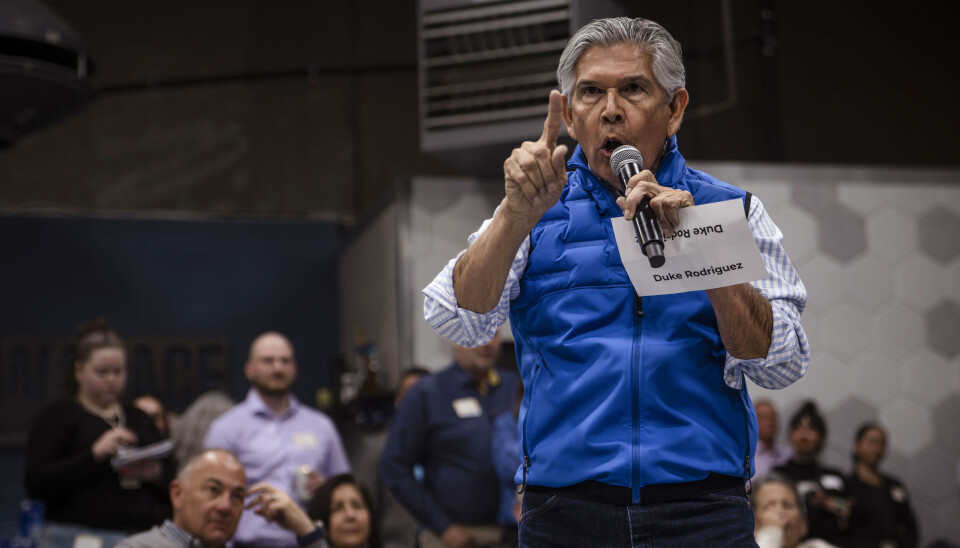

Published
Modified
Duke Rodriguez began his working life as a boy picking fruits and vegetables in California's Imperial Valley alongside his parents.
At 32, he was named chief operating officer at Lovelace Health System at a time of rapid growth for the company.
More recently, Rodriguez founded New Mexico's largest cannabis company, which he started in Arizona in 2012. Along the way, he served in then-Gov. Gary Johnson's Cabinet and drew fire by converting the state's Medicaid program to a managed-care model.
Now he is asking voters to elect him as New Mexico's governor, which he describes as a "vision" he has had since he was a young man in Silver City.
Rodriguez, 68, will face off June 2 in a three-way Republican primary against business owner Doug Turner and three-term Rio Rancho Mayor Gregg Hull.
"Duke," as he introduces himself in campaign appearances, is self-funding his campaign for governor, so far donating more than $1.5 million of his personal fortune, he said. State records show his campaign had raised $1,507,748 and spent $994,395 as of May 12.
"I grew up with nothing," he said. "If I end with nothing, so what?"
Rodriguez said he is unconcerned by a recent Journal Poll that shows him in last place against his Republican opponents with support from 9% of GOP voters, with another 40% undecided. His television, print and billboard advertising only started on May 1 and he has strong support among independent voters, he said.
"We're still basically lacing up our tennis shoes," he said.
Recurring dream
Rodriguez is president and CEO of Ultra Health LLC, with 25 cannabis dispensaries statewide and the state's largest growing facility 鈥� an 11.3-acre property in Bernalillo that Rodriguez purchased for $2.75 million in August 2014 on behalf of Zoned Properties Inc., an Arizona company in which he was a minority owner.
Rodriguez became sole owner of the property as a result of a legal settlement with Zoned Properties, according to the public company鈥檚 financial disclosures.
Today, Rodriguez describes himself as a "figurehead" for Ultra Health, which is largely operated by others. "It's not as much fun as it used to be," he said.
Why does Rodriguez want to become governor?
"I have had this recurring dream, vision, belief 鈥� call it whatever category that fits your faith," he said. "I saw myself as the governor in this state. I could even see my nameplate in wood with the Zia symbol on both ends."
His goals often seem impossibly lofty. Rodriguez said he wants to "eliminate" taxes in three categories: the state personal income tax, gross-receipt taxes on retail sales and the state's share of property taxes. The cuts would save the average New Mexico family $2,000 a year, he said.
He estimates the hit to state revenue at $1.5 billion to $2 billion, which the state could absorb from the state's surplus. The Legislative Finance Committee estimated the state's revenues at $13.9 billion for fiscal year 2027. Lawmakers this year approved an $11.1 billion budget.
Rodriguez also says the state can make better use of its sovereign wealth fund, which holds more than $70 billion, which the Sovereign Wealth Fund Institute ranks as the 29th largest in the world, and third in the U.S. behind the University of Texas and Alaska Permanent Fund.
"New Mexico is not a poor state, we are absolutely a poorly run state,鈥� he said, repeating an informal slogan of his campaign.
Rodriguez said New Mexico could do a better job of enhancing the value of its sovereign wealth fund, for example, by building oil refineries within the state. He predicts the fund's value will soar due to the recent spike in oil prices.
Rodriguez keeps his attorneys busy. A lawsuit filed by Rodriguez in April challenging state-subsidized childcare for all New Mexico families has drawn fire from Gov. Michelle Lujan Grisham, who has championed the program.
"That's the way Duke operates," former state Sen. Gerald Ortiz y Pino said of the lawsuit. "He's very much the iconoclast鈥� the Don Quixote of public policy."
A judge on April 29 gave Early Childhood Education and Care Secretary Elizabeth Groginsky a 30-day deadline to show why rules governing the program should not be struck down.
Lujan Grisham called the lawsuit "frivolous" and responded by calling Rodriguez "a third-tier Republican candidate for governor 鈥� who lives in Arizona."
Rodriguez's residency is an issue in the campaign. He owns houses in both Albuquerque and Scottsdale, Arizona, where he first registered to vote in 2001 and cast votes in the 2022 and 2024 general elections, according to Maricopa County records.
He voted last year in Albuquerque's local election and runoff and was certified as a candidate by Secretary of State Maggie Toulouse Oliver's office after filing the necessary paperwork. He has fended off two court cases challenging his eligibility for office based on residency and contends he has lived continuously in New Mexico for more than 50 years.
Humble origins
Reuben M. "Duke" Rodriguez grew up in Imperial, California 鈥� the second of five boys born to migrant field workers.
At age 14, Rodriguez, his mother and brothers moved to Silver City at the recommendation of neighbors who "talked about this beautiful place called New Mexico," he said. His father didn't follow and fell out of the family's lives.
Rodriguez attended junior high school in Silver City and high schools in Silver City and Alamogordo while his mother worked as a maid in local hotels.
In his early 20s and with an accounting degree from New Mexico State University, Rodriguez landed a job at Lovelace Health System in 1980. He was named chief financial officer in 1988, then chief operating officer in 1989 before leaving the company in 1993 at age 35.
"Lovelace has been the professional love of my life," he said in a recent interview. "No other place would have given a young person that many opportunities when they really didn't have an obligation to."
At the time of Rodriguez鈥檚 resignation, then-Lovelace CEO Derick Pasternack told the Journal that Rodriguez had played a major role in growing Lovelace from an Albuquerque hospital into a statewide healthcare and insurance business.
During his tenure, nonprofit Lovelace reorganized into a for-profit company in 1985, jointly owned by the Hospital Corporation of America. Lovelace also built the 230-bed Lovelace Medical Center at 6400 Gibson SE, now the city-owned Gateway Center.
"I never suspected that someday it would become a shelter for homeless people," he said of the former hospital. "That shows you how much Albuquerque has declined."
Rodriguez, now divorced, said he married at a young age and has a son, Justin D. Rodriguez, who is an attorney in Albuquerque.
After resigning from Lovelace in 1993, Rodriguez served as CEO of Diagnostek, an Albuquerque-based pharmacy services firm. He left the firm 15 months later, saying he wanted to take some time off.
His affection for Lovelace notwithstanding, Rodriguez quietly filed a whistleblower lawsuit against Lovelace in 2009 on behalf of himself and New Mexico alleging the company cheated the state Medicaid program out of $300 million, the Santa Fe New Mexican reported.
Under a 2015 settlement, Lovelace and Ardent, which bought Lovelace in 2002, paid the state $2 million and Rodriguez $500,000, the New Mexican reported. Both companies denied wrongdoing.
Cabinet secretary
In July 1996, then-Gov. Gary Johnson tapped Rodriguez as his state Human Services secretary, a post he held until October 1997. During his tenure, Rodriguez led the effort to convert the state's Medicaid program from a fee-for-service model to managed care.
"That was the great promise in those days," Ortiz y Pino recalled. "Managed care was going to really help the state take care of medically needy people. It hasn't panned out that way, but he was adamant in pursuing that."
Johnson, who served as governor from 1995 to 2003, said he considered it a coup that Rodriguez agreed to serve in his Cabinet.
"I was really happy that he would take the job in the first place given his background at Lovelace," Johnson said. He praised Rodriguez for steering the state's Medicaid program to a managed-care system.
"That was 100% Duke," Johnson said in a recent phone interview. "He made it happen and it's still in existence today." Johnson contends managed care has saved the state millions of dollars in Medicaid funding.
Rodriguez's tenure as Cabinet secretary had its share of controversies. Rodriguez came under fire after the state Supreme Court ordered a halt to the Johnson administration's welfare reform program, which included work requirements that significantly reduced welfare roles in New Mexico.
At the time, Johnson praised Rodriguez's work but said his resignation was "probably the right thing for him to have done given that the focus was on him and not managed care for Medicaid and not welfare reform."
His resignation also came three days after the 近距离内射合集 reported that a firm he formed had received nearly $30,000 in sales commissions from a company that did business with Human Services.
The Journal reported that Healthcare Business Solutions Inc. of Albuquerque paid $29,822 earlier that year to Cumbre Investment, formed by Rodriguez in 1994.
Rodriguez recently disputed the Journal's coverage and said he had never been president or a board member of Cumbre Investment.
"I did not receive compensation from any company, period," he said. Rodriguez said his work initiating Medicaid managed care upset many people in the state and opened him up to personal attacks. Rodriguez also said he felt uncomfortable leading Johnson's welfare reform effort.
"I came in with the agreement and understanding that my primary mission wasn't even welfare reform," he said. His job was "solely to do one thing 鈥� bring managed care Medicaid to fruition, and I did it."
Olivier Uyttebrouck covers the court system. You can reach him at olivier@abqjournal.com.
Other profiles of gubernatorial candidates
-
Doug Turner vows to be independent, pragmatic governor: 'We all have the same end game'
GOP hopeful touts experience, big fundraising haul and a focus on taxes, schools and crime
-
Deb Haaland's unlikely rise to political prominence: 'I never gave up on myself'
Democratic gubernatorial candidate says she's not worried about criticism as she seeks party's nomination
-
'I'm not beholden to anybody,' Bregman says
County DA rides into June 2 primary by declaring he'll govern for everybody, not just political class
-
Rio Rancho's longest-serving mayor eyes governor's office
Republican Gregg Hull says his decade as Rio Rancho's mayor gives him a unique edge in the three-way GOP primary race for governor


