NEWS
Independents' ranks swell after implementation of new voter registration system
Of state's 70,000-plus new voters since last summer, more than 80% declined to state party affiliation

Published
Modified
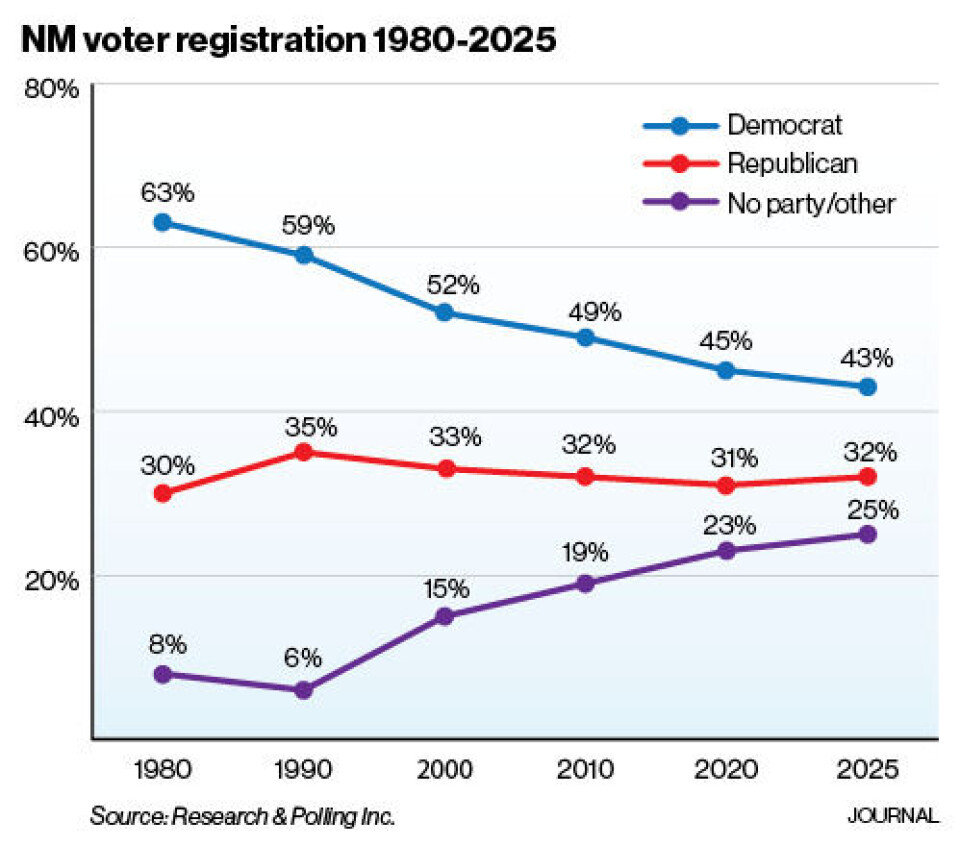
SANTA FE 鈥� For the last three decades, the ranks of New Mexico independent voters have been growing at a more rapid rate than registered Democrats or Republicans.
But that trend has accelerated in advance of the state鈥檚 first semi-open primary election 鈥� set to take place in June 鈥� and after implementation of a new statewide automatic voter registration system.
Since the new system was enacted in July, the number of independents in New Mexico, or those who decline to affiliate with a political party, has increased from 314,017 to 371,380 as of March 31 鈥� a 57,000-plus voter increase that averages out to nearly 6,400 new voters per month.
In the three months prior to the implementation of the system, the number of independent voters had increased by an average of about 1,500 voters per month.
In contrast, the number of registered Democrats over the last nine months increased by an average of just 371 voters per month, according to . As for Republicans, the number of GOP voters during the same time period grew by an average of roughly 913 voters per month.
Looking at it another way, about 82% of the state鈥檚 newly registered voters since last summer declined to state a party affiliation.
Longtime New Mexico political observer Brian Sanderoff said the proportion of independent voters in the state has been increasing for years but ramped up noticeably after the state began automatically registering eligible residents to vote last summer at Motor Vehicle Division field offices.
鈥淣ewly registered voters under the automatic voter registration system are just more likely to register as unaffiliated,鈥� said Sanderoff, who is the president of Albuquerque-based Research & Polling Inc.
While he said he does not anticipate a high vote turnout among independent voters in this year鈥檚 primary election, he said the meteoric rise could lead to big changes to the state鈥檚 political landscape in the future.
鈥淚 think this trend, in conjunction with the change in law allowing independents to vote in primary elections, will have a major impact over time,鈥� Sanderoff said.
He also said the semi-open primary law could eliminate an incentive for new voters to affiliate with a political party, since independent voters can now cast a ballot in either the Republican or Democratic primary.
Independent voters were previously barred from voting in New Mexico primary elections unless they changed their party affiliation, but that is changing this year under the law signed by Gov. Michelle Lujan Grisham that created a semi-open primary system.
Political impact of independents鈥� rise
The recent surge in independent voters hasn鈥檛 gone unnoticed by candidates running for statewide office this year.
Republican gubernatorial candidate Duke Rodriguez said last fall the rise of unaffiliated voters could mean New Mexico voters are shedding traditional political labels.
Another GOP candidate, small business owner Doug Turner of Albuquerque, attributed the trend to New Mexicans鈥� core identity.
鈥淚 think that speaks to the fact that we are a wildly independent state,鈥� Turner said at a recent Journal town hall event. 鈥淧eople like to run their own show and keep their business their own business, but they want to support people who also agree with them.鈥�
However, Sanderoff cautioned that independent voters, who tend to be younger than registered Democrats and Republicans, have voted at lower rates in recent election cycles.
In last year鈥檚 regular local election in Albuquerque, for instance, only about 21.7% of registered independents voted, compared to 41.5% of Democrats and 36.8% of Republicans.
In addition, Sanderoff pointed out that independent voters who do cast a ballot in the June 2 primary election will be split, since some will select a Democratic ballot and others will opt to receive a Republican ballot.
If 10% of the roughly 371,000 unaffiliated voters end up casting a ballot, that means the 37,100 votes will be divided between the two major political parties, which could dilute the impact of independents in determining races鈥� outcomes.
Will new voters end up voting?
The new automatic voter registration system was launched last year under New Mexico鈥檚 latest plan to expand voting access.
The system stems from a 2023 state election bill approved by lawmakers 鈥� via a vote that broke down largely along party lines 鈥� and signed into law by Lujan Grisham.
Since the system鈥檚 launch in July 2025, a total of 62,653 new voters have been registered in New Mexico at Motor Vehicle Division field offices, according to Secretary of State鈥檚 Office data. That represents the bulk of the state鈥檚 70,199 total newly registered voters during that time period.
An additional 201,371 voters have used the system to update their registrations, while 671 new registrations have been declined because applicants did not meet necessary requirements to be voters.
Lindsey Bachman, a spokeswoman for the Secretary of State鈥檚 Office, said it鈥檚 possible there鈥檚 a link between the launch of the new system and the surge in independent voters statewide, but said the office could not 鈥渃onfirm a correlation.鈥�
She also said individuals are given the option of selecting a party affiliation on electronic signature pads they use when completing MVD transactions.
But how many of the newly registered voters end up casting a ballot is a big question as election officials ready for voting to begin next month.
Only 25.2% of registered voters cast a ballot in New Mexico鈥檚 last primary election in a nonpresidential year, which took place in 2022.
Dan Boyd covers state government and politics for the Journal in Santa Fe. Follow him on X at or reach him via email at dboyd@abqjournal.com.


