COURTS
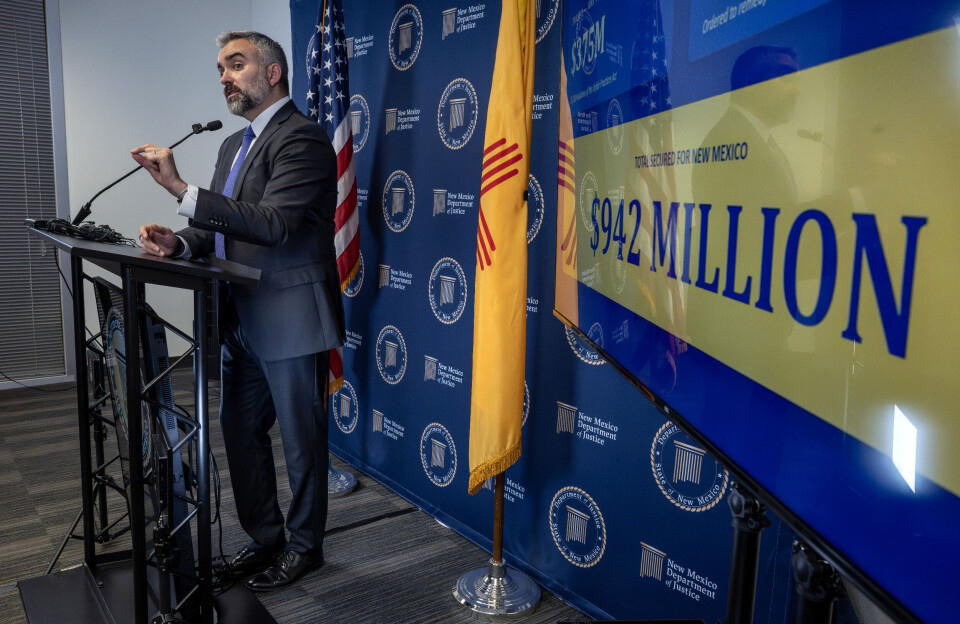
Torrez: Elected officials will decide how to spend Meta award totaling $942 million
Attorney general says elected officials will control spending of the landmark award while Meta plans to appeal

Published
Modified
New Mexico's governor and lawmakers will play key roles in deciding how to spend a $567 million judgment against Meta Platforms Inc., Attorney General Raúl Torrez said Friday, a day after a Santa Fe judge handed down the award.
But it remains unclear when Meta will be required to make both that payment and an additional $375 million jury verdict awarded to New Mexico in a trial in March, said Torrez, who filed a 2023 lawsuit that resulted in both judgments.
"Our job is to win in court, recover funds, and make sure that court orders are honored," Torrez said at a news conference Friday. But decisions about how to appropriate the money will lie with New Mexico's elected leaders, he said.
"This will be the job of the executive branch and the legislative branch,� Torrez said. “The legislative branch to appropriate to specific programs that fit within these categories, and the executive branch to then facilitate and ensure that those monies are expended in a way that serves the ultimate purpose identified by the court."
Meta, which owns online platforms including Facebook, Instagram and WhatsApp, said Thursday it plans to appeal the rulings, which could complicate the timeline for the payment and other measures ordered Thursday by 1st Judicial District Judge Bryan Biedscheid.
"But we will be pressing the court to order the payment of these funds as quickly as possible," leaving it for appellate courts to decide about other measures ordered by the judge, Torrez said. He predicted that Meta’s appeal will fail.
Under Biedscheid's order, the $567 million award will fund programs over five years focused on youth mental health awareness and prevention, screening and assessment, referrals and coordination, treatment and evaluation. The largest portion of the funds — $420 million — will go toward treatment efforts.
Torrez filed the suit against Meta Platforms and CEO Mark Zuckerberg in 2023, alleging the company failed to protect children from sexual abuse, online solicitation and human trafficking.
New Mexico also alleges Meta's design features, including autoplay, endless scroll and push notifications, "directly contribute to addictive and problematic use" among New Mexico teens and children.
Torrez also said Biedscheid’s order provides a blueprint for ways that state and federal lawmakers can better regulate social media platforms.
“Throughout the order, the judge referenced opportunities that existed for both the legislative and executive branches to step in and provide more comprehensive guardrails for companies like Meta and social media generally,� he said.
Biedscheid found that design elements in Meta platforms such as autoplay, infinite scroll, like counts and push notifications make the platforms "irresistibly compelling to start scrolling and very difficult to stop." But he wrote that many remedies "require legislative or executive branch action" that impose industry-wide restrictions.
However, the judge ordered Meta to eliminate push notifications for users under 18 from 10 p.m. to 7 a.m. and from 8 a.m. to 3 p.m. on school days during the academic year. He also ordered Meta to limit social media usage to 90 hours per month for users under 18.
Age verification
The New Mexico Department of Justice also reserves its right to appeal portions of the order that fell short of the changes New Mexico sought to Meta's platforms, he said. For example, New Mexico asked the court to require Meta to apply rigorous age-verification tools on its platforms.
Biedscheid wrote in his 67-page order that while he agrees better age verification is needed to ensure child safety, the measures sought by New Mexico exceed the authority of the court and may violate federal law.
In his order, Biedscheid cited a 1998 federal law, the Children's Online Privacy Protection Act, which he said prohibits a judge from ordering "Meta to request children submit personal data or be passively tracked online, even for age-verification purposes."
Biedscheid wrote that age verification is essential to prevent children under 13 from using Meta platforms and prevent adults from communicating with adolescents. But he wrote that the regulatory solutions to these problems lie in the executive and legislative branches, not with the court.
However, he ordered Meta to continue improving its age assurance model and tools, such as using images and posts to help determine a user's age and make it easier for school administrators and others to report underage users. Meta prohibits children under 13 from creating social media accounts.
Torrez called for "comprehensive federal legislation and, in parallel, comprehensive state legislation, starting with real age verification" and said his office will speak with lawmakers about age verification using "rapidly advancing and evolving technology."
Law enforcement
Torrez said he was especially pleased that the judge ordered Meta to maintain a 24/7 point of contact for the New Mexico Department of Justice's Internet Crimes Against Children division and to improve Meta's system for reporting internet sex crimes.
Biedscheid also ordered Meta to prepare and pay for semiannual trainings for state and federal law enforcement related to internet crimes against children.
New Mexico’s two court battles against Meta “have conclusively shown that this platform is a breeding ground for predators,� Torrez said. “It is a place that facilitates not only hands-on abuse but the identification and market-driven practices of child pornography.�
Olivier Uyttebrouck covers the court system. You can reach him at olivier@abqjournal.com.


